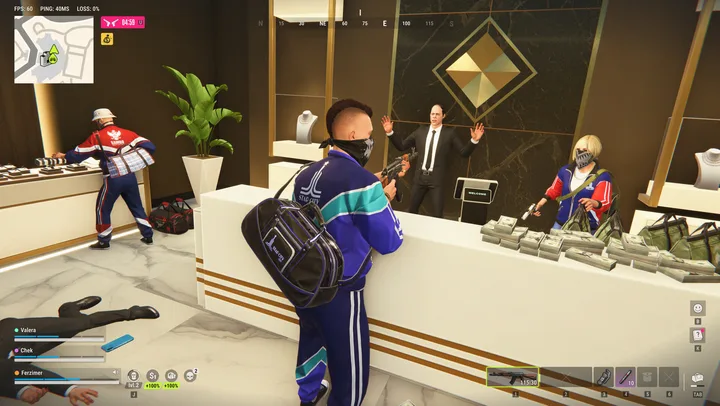
A good ROB RUN heist plan includes the time before the first threat and the journey after the last container. This guide explains the confirmed sequence and practical crew decisions. It does not label every target a guaranteed profit route or pretend that an expensive loadout solves a poor exit.
If you are completely new, use the beginner route first. For the complete transaction after extraction, follow selling loot and making money. Keeping those jobs separate helps you diagnose whether an attempt failed at preparation, execution or payment.
Scout before putting on a mask
Observe the building and plan how you will leave before enabling robbery. Identify the entrance you will use, a route back out and the destination after the target. Knowing a building is not the same as knowing a route through the street outside it.
This scouting stage is where you decide whether the job is worth attempting with your present equipment. If you cannot explain the getaway, postpone the commitment. A small job that lets you learn a clean sequence is a more useful practice run than a larger one chosen only for an advertised reward.
- Locate the target and look over the surrounding streets.
- Choose an exit and a transport plan.
- Agree on the sale or storage destination.
- Confirm your crew understands when the attempt starts and when it ends.
Understand Criminal status before the robbery
Putting on a mask allows robberies, but police and other Criminals can attack you. City Criminal death risks inventory. Your decision should therefore include both the valuables you hope to take and the equipment you brought into the situation.
Kefir says leaving the city clears Criminal status. Do not build an escape plan around taking the mask off in the same building. Check the role and location loss matrix if you are unsure how surrender, death or a move into the desert changes the stakes.
Split the work before anyone starts hauling
The official heist advice identifies break-in, hauling and cover as distinct tasks. With teammates, assign responsibility so that everyone does not look away from the same risk at once. A clear job is more useful than several people independently reacting to the same moment.
For solo play, think through those tasks in sequence rather than assuming you can perform them simultaneously. If an interaction keeps your attention fixed on an object, decide beforehand how you will stop and reassess. The guide does not assume a particular tool or prompt for every building.
| Task | Question to settle before committing |
|---|---|
| Access | Who handles entry and recognizes a failed interaction? |
| Staff control | Who keeps staff covered while others work? |
| Hauling | Who collects goods and knows the next destination? |
| Cover and departure | Who watches the exit and calls the retreat? |
Keep staff control and the exit in the plan
Kefir recommends holding staff at gunpoint so they do not raise an alarm. That is one reason not to have the whole crew concentrate on collecting loot. Continue checking the situation rather than treating a quiet first interaction as proof that the rest of the building is safe.
Set a retreat condition while you can still think clearly. You might choose to leave when the agreed haul is collected, when a teammate is unable to continue or when the exit no longer looks manageable. These are planning suggestions; the game does not guarantee that waiting longer will pay for the extra risk.
Leave with a destination, not just a direction
The getaway should connect to a useful next action: a fence, storage or another planned stop. Reaching a vehicle is only an intermediate point. Use the map and services guide to understand the route, and avoid choosing a destination only after you are already carrying valuables.
Vehicle trunks are not an invulnerable vault: the official transport help describes lockpicking other players’ trunks, including police cars. Think about what remains exposed during travel. If your plan needs a vehicle you do not own, verify the rental conditions before you start.

Decide whether another target is worth the commitment
A streak during the same city visit can improve Notoriety, fence terms and perks. Solo players and duos start with a higher Notoriety level in Kefir’s description. Those advantages do not remove the risk attached to valuables already collected.
Before continuing, compare the purpose of the next job with your exit and current haul. The relevant decision is whether you want to commit again, not whether a streak makes the next result certain. Keep city heists separate from attacks on player bases: a base raid uses Security Systems and Decoders, rather than making the Decoder a required tool for every city target.
Finish the sale and review one mistake at a time
At the fence, collect the cash from the counter after selling. Then decide how to handle it. A clean robbery followed by an uncollected payment is still an incomplete money route. Laundering is a separate base process, not something a fence automatically does for you.
After a failed attempt, identify the stage that actually broke: scouting, staff control, hauling, departure or sale. Improve that stage on the next run rather than replacing every part of the plan. Also avoid judging a route by one unusually quiet or unusually contested trip.
- No clear exit: scout again before increasing equipment costs.
- Too many people hauling: assign cover explicitly.
- Goods lost in transit: revisit the destination and transport plan.
- Cash still exposed: learn the banking prerequisites before repeating bigger jobs.
Heist Guide FAQ
01Does removing my mask clear Criminal status?
The official heist article says you clear Criminal status by leaving the city. Do not rely on removing the mask as an escape from the role’s consequences.
02Can another Criminal attack me?
Yes. The official description names both police and other Criminals as threats after you mask up. Do not assume every player at a target is an ally.
03What does Notoriety do during heists?
Heist streaks during a city visit raise Notoriety, which can improve fence deals and unlock perks. It does not guarantee that you will keep the loot from another target.
04Can I save equipped gear by surrendering?
The police surrender guidance says your bag is confiscated while equipped gear is retained. That is different from dying as a Criminal, and different from surrendering to the feds.
Sources & useful references
Game rules below are linked to their official references. Tactical suggestions in this guide are practical advice, and do not promise a particular payout or outcome.