How to make money in ROB RUN depends on what you already have. A new player can attempt a small robbery without owning a production base, while a settlement owner earns through a different system entirely. This guide compares the paths and explains the sale process without inventing hourly earnings.
Separate income from protection. Goods, cash and laundered funds are not interchangeable states. If a route looks profitable only because it ignores stolen cash, lost equipment or setup costs, it is not a useful route comparison.
Compare the confirmed income paths
Kefir confirms several ways to earn, but does not publish a universal fastest route that suits every character. The right starting point depends on access, equipment and how much you are prepared to lose. Use the table to choose a system to learn, not to predict a fixed payout.
| Path | What you do | Main planning question |
|---|---|---|
| Loot and heists | Collect valuables and sell them | Can you get the goods to a fence? |
| Cargo | Haul and trade cargo | Do you understand the delivery and transport cost? |
| Production | Produce goods at a base | Do you have the setup and time to use it? |
| Police | Make arrests and seize contraband | Are enlistment slots available? |
| Territory | Collect ownership or control income | Can you obtain and maintain the relevant position? |
Build a first route around an exit, not a headline payout
For early earnings, pick a robbery you understand and decide where you will go afterward. The heist guide covers scouting and staff control; this page focuses on what turns the result into usable money. Do not include the value of loot you cannot reliably extract in your personal profit estimate.
Compare completed trips. Count what you actually brought back, what you spent and what you had to replace. A route that succeeds regularly may be more useful to your character than a spectacular target you cannot finish. This is a budgeting method, not a claim about which target is mathematically optimal.
- Choose a target and a reachable sale destination before entering.
- Bring equipment you can afford to replace.
- Finish the sale and collect payment before assessing the result.
- Subtract supplies and replacement costs from the cash you actually kept.
How to sell loot and collect cash
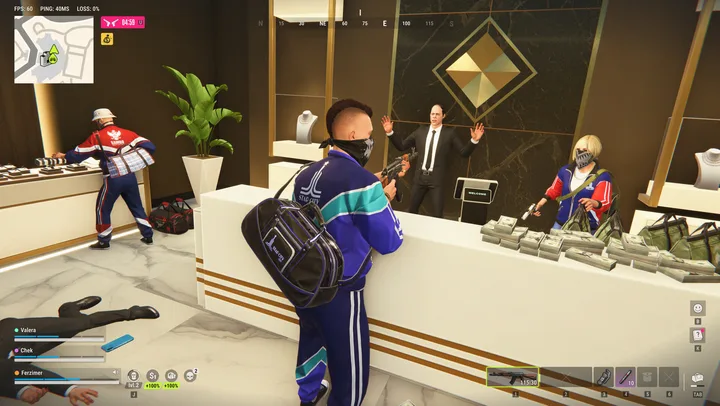
Find the fence at a van marked with a dollar sign on the Looty Bay map, or go through the Sales Center. Sell the valuables and take the payment from the counter immediately. Cash left behind can be stolen or confiscated, so do not walk away as soon as the transaction completes.
Look at the offer before you confirm a sale. Notoriety can improve fence deals, according to the official description, so a figure from another run is not necessarily the offer in front of you. If an item might be useful for a later activity, compare that purpose with the cash offer instead of treating every inventory slot as automatic sale material.
- Locate the fence using the dollar-sign marker or Sales Center.
- Check the valuables selected and the offered return.
- Complete the transaction and collect the cash from the counter.
- Move to your planned next destination rather than leaving the payment exposed.
Treat Notoriety as a risk-and-return choice
A heist streak in one city visit raises Notoriety and can improve fence deals and unlock perks. That creates a reason to continue a run, but it does not remove the possibility of losing what you are carrying. Better terms are valuable only if you reach the transaction.
Decide a stopping point before chasing another target. For example, you might stop when you have enough for a planned purchase or when the escape route becomes unreliable. That is a practical limit you choose; it is not a hidden game bonus. Compare the extra opportunity with the cost of losing the completed part of the trip.
Compare cargo trading with base production
Cargo trading and production solve different tasks. For cargo, inspect the goods, the transport needed and the actual sale offer. For a production plan, first confirm that you can access the base facility and obtain the inputs it needs. Do not count a finished product as profit before accounting for how you obtain and move it.
Use two budgets when comparing the choices: the immediate trip and the setup needed to repeat it. A player without a working production base should not compare an instant cargo offer against a hypothetical output they cannot yet make. The official income list confirms both paths, but your live offers and prerequisites determine the useful comparison.
Police pay and settlement income have different entry costs
Police work starts at Looty Bay Police Station when slots are open. Kefir describes issued equipment, a patrol vehicle and pay for enforcement and seized contraband. Settlement income instead depends on owning rentable land and collecting a share of tenant activity in person.
Choose between them according to access and the activity you intend to perform. Policing is a role you enter; settlement ownership is a purchase and collection system. Neither should be represented as a passive hourly salary without checking its conditions.
Protect the proceeds before increasing your spending
Cash can be stolen or confiscated. Banked, laundered money is protected from theft until a wipe. Follow the bank account and Laundering Desk steps to understand what is required, and do not assume opening an account instantly secures everything in your bag.
A base can support storage and production, but it introduces its own investment and raid decisions. Keep enough flexibility to replace the tools you use to earn. Spending the entire return on an upgrade can leave you unable to repeat the activity that paid for it.
Choose an upgrade that removes a real bottleneck
Identify the part of your route that is holding you back. If the problem is getting away, look at transport and route knowledge before a more expensive weapon. If cash protection is the issue, investigate the base and laundering prerequisites. If you want territory income, first learn what settlement ownership actually involves.
Avoid adding several systems at once just because the money is available. Record what the upgrade is meant to improve, make the change and compare the next completed runs. Also check the Federal Raid rules: money earned in a server cycle should have a purpose within that cycle.
- Buy for a problem you can describe, such as storage, transport or access.
- Check an item’s actual menu price and prerequisites before budgeting.
- Keep equipment replacement in the plan.
- Do not confuse bank protection from theft with protection from a wipe.
Make Money & Sell Loot FAQ
01What is the fastest way to make money?
There is no verified universal hourly route here. Use a method your equipment and access can support, then compare the money you actually keep after expenses and failures.
02Can police earn money too?
Yes. Kefir describes income from fighting crime and seizing contraband. The police role has station availability and badge progression rather than the same setup as a criminal route.
03Does Lenny store all my loot?
No. The official storage article distinguishes cash at Lenny’s from stolen goods stored at a base. A base can still be raided.
04Why did selling loot not leave me with the expected cash?
Check whether you collected the payment from the counter, what the transaction selected and the actual offer. The money on the counter remains exposed until you pick it up.
Sources & useful references
Game rules below are linked to their official references. Tactical suggestions in this guide are practical advice, and do not promise a particular payout or outcome.