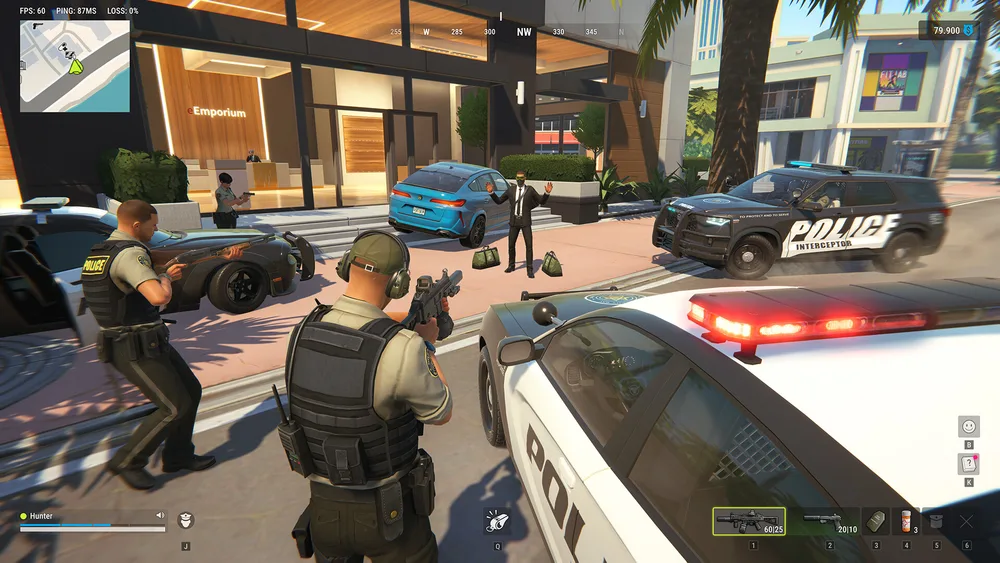
Becoming a cop in ROB RUN is a playable role with an availability condition, not a permanent promise that every visit to the station will admit you. This guide covers the confirmed entry point, equipment, progression and the loss rules that distinguish police from Criminals.
The practical advice below concerns preparing for the role and understanding its systems. Exact salaries, badge thresholds and equipment prices are not invented where the official help does not provide them.
Enlist at the Police Station when a slot is open
Use the Looty Bay Police Station as the official entry point. The help article makes open slots a condition for joining. If the option is unavailable, check that condition and the message shown by the interaction before treating it as a technical failure.
Plan the visit as a role decision. If you were preparing a criminal robbery, reassess the equipment, objective and route instead of assuming both activities have the same rules. The beginner guide explains the broader choice of starting activities.
- Find the Police Station in Looty Bay.
- Check the enlistment interaction and whether slots are available.
- Read any condition shown for your character.
- Enlist and inspect the issued gear and patrol vehicle before setting out.
Inspect issued gear and separate personal equipment
Kefir says new officers are issued standard equipment and a patrol vehicle. Check what you have actually received and what remains your own property. This distinction becomes important when you evaluate a death or decide what you can afford to take into an encounter.
Do not assume a particular weapon name or vehicle upgrade is part of every entry kit. The referenced help establishes the role and progression, not an immutable inventory list. Use the weapon comparison guide to think about the loadout rather than treating an older screenshot as the current issue sheet.
How police pay and badge progression fit together
The official description ties earnings to fighting crime and seizing contraband. Leveling the badge unlocks better equipment. These are related forms of progress, but an unlock is not necessarily the same thing as cash immediately arriving for a purchase. Read the live role interface when planning the next step.
Kefir’s First Changes & Server Schedule announcement also makes police badges purchasable, with selection tied to the district where you live. Fresh-server patrols initially have pistols, with better equipment opening as the server ages. Check the available badge and issued kit rather than assuming every server starts with the same advanced loadout.
Kefir also describes backup calls when officers are stretched thin, with temporary improved gear and pay for those who respond. Treat the actual call and its conditions as the authority. Do not assume a pay boost is permanently active or available whenever you choose.
| System | Confirmed function | Do not assume |
|---|---|---|
| Enlistment | Depends on open slots | Admission on every station visit |
| Issued kit | Standard gear and patrol vehicle | One permanently fixed weapon list |
| Badge progression | Unlocks better equipment | An unsourced level threshold |
| Backup response | Temporary improved gear and pay | A permanent boost to every shift |
Know what surrender and bribery change
Ordinary surrender lets a Criminal preserve equipped gear while the bag is confiscated. If the officer accepts a bribe, the Criminal can retain the bag contents as well. Kefir says the offer depends on money in the player’s bank account and acceptance by the cop.
Acceptance is a condition, not a guaranteed escape button. The banking guide explains how funds reach the account; the heist guide covers the Criminal’s side of the encounter. Neither page should be read as a promise that another human player will agree to a deal.
Police death has its own loss rule
The official death help distinguishes department-issued gear from personal items and equipment for officers. Do not apply the Criminal inventory rule to every role simply because the fight happened in the same city. The death matrix puts the conditions next to each other.
Location remains important. The same official article describes the desert as a place where death means losing loot. If you are planning to leave city policing for another activity, review the relevant location rule before assuming the city example protects every item in a new situation.
Build a policing routine you can explain
Before an encounter, know your role, what equipment is issued and what result you are trying to achieve. Afterward, check the actual reward or loss rather than judging only by the appearance of a defeated character. This habit helps distinguish a role rule from a bug report.
If enlistment, equipment or progress behaves unexpectedly, record the station interaction or message and the steps immediately before it. A specific description gives official support something to assess; “the role is broken” does not identify which part failed.
- Check slots before planning an entire session around enlistment.
- Distinguish issued equipment from personal gear.
- Read the live conditions on backup calls and progression.
- Keep city and desert risk rules separate.
- Use official support for unexplained account or equipment behavior.
Become a Cop FAQ
01Why can I not become a cop right now?
The documented entry condition is an open slot at the Looty Bay Police Station. Read the actual interaction message before assuming a missing option is a client bug.
02Do officers receive a vehicle?
Kefir describes a patrol vehicle as part of the standard issue. Inspect the current kit and vehicle provided rather than relying on a fixed list from another player.
03Is every bribe accepted automatically?
No. The official wording makes officer acceptance a condition. The Criminal needs bank funds to offer a bribe, and the other player still has a decision.
04What happens to police equipment on death?
Under the Looty Bay role rule, department-issued equipment is lost while an officer’s personal items and equipment remain. The desert has a separate all-loot loss warning.
Sources & useful references
Game rules below are linked to their official references. Tactical suggestions in this guide are practical advice, and do not promise a particular payout or outcome.